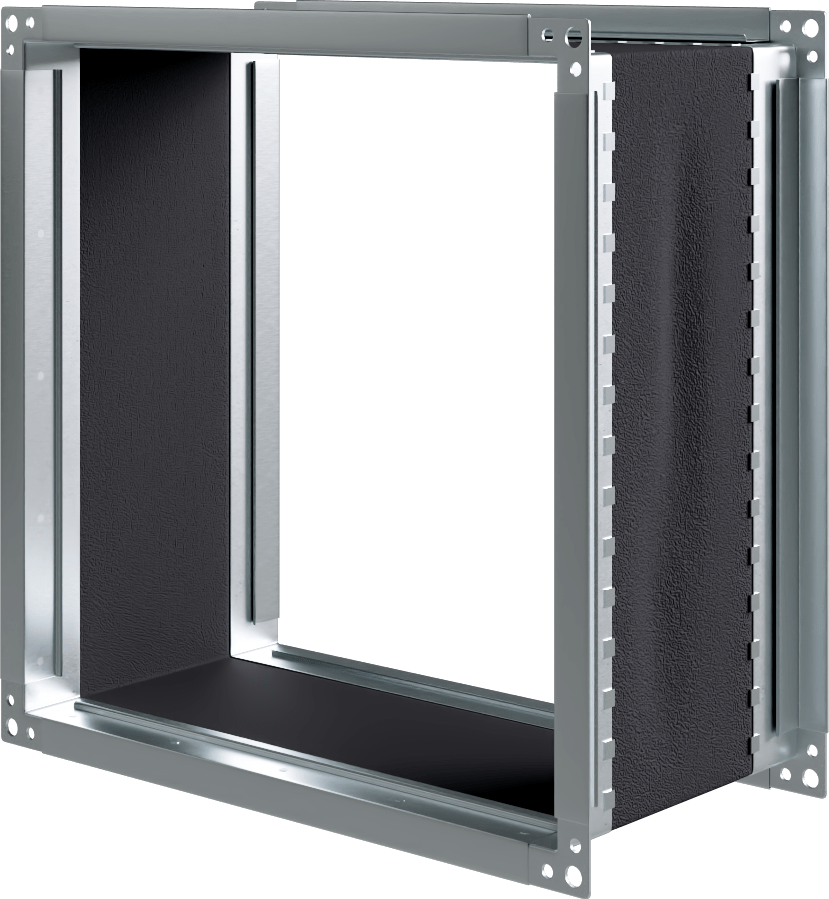
Rectangular flexible connectors provide vibration isolation and flexibility in rectangular duct systems. They improve system durability and reduce noise by minimizing structural stress.
These components are commonly installed between mechanical equipment and ductwork to interrupt vibration transmission and protect the system structure. Their flexible design allows controlled movement, preventing deformation and potential damage during operation.
Flexible connectors are typically made from elastic materials such as reinforced fabric, PVC, or rubber, combined with metal frames for secure installation. This ensures durability and reliable performance under various working conditions.
Installation is simple and carried out using flange or standard profile connections, allowing for quick and airtight assembly. In practice, these connectors contribute to improved acoustic comfort and extended system lifespan.
| Dimension (mm) | Parameter 1 | Parameter 2 |
|---|---|---|
| 100 | 100 | Frame: S20+P20 |
| 150 | 150 | Frame: S20+P20 |
| 200 | 200 | Frame: S20+P20 |
| 250 | 250 | Frame: S20+P20 |
| 300 | 300 | Frame: S20+P20 / S30+P30 |
| 350 | 350 | Frame: S20+P20 / S30+P30 |
| ... | ... | Frame: S20+P20 / S30+P30 |
| 1000 | 1000 | Frame: S20+P20 / S30+P30 |
| ... | ... | ... |
| According to technical specification | According to Technical Specification | Frame: S20+P20 / S30+P30 |